|
||||||||
|
~ Why I Officiate at Intermarriages ~ An Interpretative Version of the Seven Blessings (Sheva Brachot) ~ Ketuba (Wedding Document) (interfaith version) ~ Wedding Glossary: A good thing to give to your guests ~ Same-sex Wedding Ceremony, Sheva Brachot & Ketuba
Why I
Officiate at Intermarriages Falling
in love with a Jewish person can be the first step in an affiliation
with the Jewish people. I cannot help but think that part of the
attraction is not just the person, but the beauty of the Jewish
tradition as it comes through the beloved. Perhaps the traditional
sequence of events doesn't always work, although even in the Bible we
know that there were among the tribes, participating in the community,
those who were not members. The people Israel were told to love them and
treat them fairly! Usually,
any couple I work with has already experienced some rejection from the
congregational rabbis whom they've asked to officiate at their wedding
(Shades of being rejected three times). They are often close to walking
away from Judaism entirely. Every couple is unique, but generally there
is a strong desire for spirituality and tradition to be present at the
wedding. A marriage commissioner/justice of the peace ceremony can't
offer that. I
commonly experience that both partners appreciate the opportunity for
Jewish content in their wedding. The non-Jewish partners frequently
express receptiveness to Judaism and to participating in the Jewish
family they are marrying into, but without ultimatums. I would hope that
is the natural direction for a person who has fallen in love with a Jew.
Certainly I know many parents who are helping to raise Jewish children
even though not 'officially' Jewish themselves. What generosity! I inform
every intermarrying couple that their ceremony under the marriage canopy
is not legal under Jewish law, but is valid as a spiritual commitment
reflecting both partners. Some of the liturgy of the traditional Jewish
wedding is not appropriate, but can be adapted so that it reflects the
beliefs and intentions of the persons involved. I use a version of the
wedding blessings that invoke ecumenical blessings for the couple. I
suggest that family and friends come forward to offer the blessings so
that the couple and family can experience that despite there being two
families from two different traditions, they unite in their support of
the loving couple. Any two
people sharing their lives will experience difficult times. Certainly
couples who intermarry will have differences to work out. Will there be
Judaism in the home? Only time will tell. My goal is to give a couple a
positive experience with Judaism in the hope that they will feel
comfortable participating in Jewish life in the future. This is good for
Jews, the people who love them and, I believe the Jewish people.
This
wedding ceremony is based on the traditional Jewish ceremony. This is
an interfaith version. I work with each couple to tailor their ceremony
to the sensibilities of all parties. Ditto for when co-officiating with
other clergy. Prior to the ceremony under the khupa, the couple signs their ketuba with the Rabbi and their witnesses (bedeken is optional at this time - it is the lowering of the veil by the groom). All parties sign the register after the ceremony.
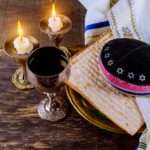
Proceed to khupa. On a small table within reach of the khupa are two Kiddush cups, an opened bottle of kosher wine, and a glass to be broken at the end of the ceremony. The glass needs to be well-wrapped. Rabbi
sings: Baruch ha’ba; mi adir (traditional Hebrew welcome to bride and
groom) Hebrew followed by English. Then Rabbi welcomes the bride and
groom and all who are present for this special occasion. First cup
of wine, symbolizing bethrothal. A few words about the significance.
Blessing over the fruit of the vine (Hebrew & English). Bride and groom
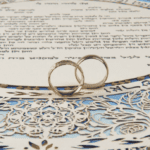
drink. Rings
(interfaith version): Repeated after Rabbi: Groom to bride: Harei at
mekudeshet li b’taba’at zo. Ani l’dodi v’dodi li. I give you this ring
so that all may know that you are sacred to me as my wife. I am by
beloved’s and my beloved is mine. Bride:
Harei atah mekudash li b’taba’at zo. Ani l’dodi v’dodi li. I give you
this ring so that all may know that you are sacred to me as my husband.
I am by beloved’s and my beloved is mine. Rabbi:
Reading of Ketuba (marriage covenant document) In a combination of
Hebrew and English. Couple may chose to repeat the ketuba vows at this
time. Sheva
Brachot-Seven Wedding blessings over the second cup of wine: Combination
of Hebrew and English (A contemporary English version follows that many
interfaith couples have used). Bride and groom drink. Rabbi
explains significance(s), then groom breaks the wrapped glass. Mazal tov!
Spontaneous singing and celebrative noise. The couple kiss or not, as
they choose, and walk out to joyful music/singing. Yichud-couple
have time alone.
Wedding at Vancouver
The middle 5 can be read by friends and relatives.
About
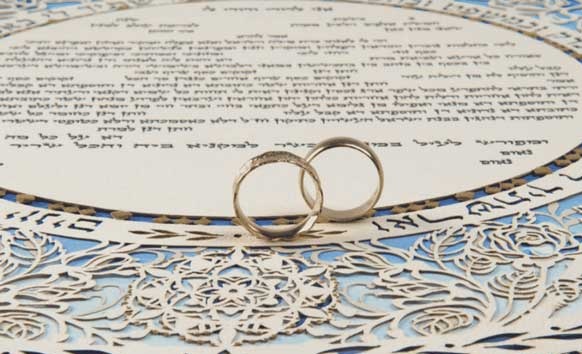
Ketubahs: I can produce a simple one-page ketuba in English
and Hebrew using this text. Many couples like to have an artistic ketuba
prepared for them. There are many options on the internet. Allow plenty
of time for your artistic ketuba to be prepared.
The Ketubah:
Just prior to the
ceremony, the bride and groom, Rabbi Dina Hasida Mercy and 2 witnesses
will sign the Ketubah, a modern (interfaith) version of the Jewish
marriage contract, which has been used in Jewish marriage for over 2000
years.
The Khupa (Wedding Canopy):
The khupa is held by friends and relatives of the couple. This
represents the community that will help the bride and groom establish a
home. The wedding canopy symbolizes many things: it is a home, a
garment, a bedcovering, and a reminder of the tents of nomadic
ancestors. The khupa is understood as a sign of divine presence at the
wedding and in the home being established under the canopy. Khupa means
“that which covers or floats above,” and the space beneath it is said to
be spiritually charged. The Ceremony: The wedding ceremony used to be two separate ceremonies. Erusin (bethrothal) and Nissuin (marriage) held up to one year apart. Since life can be precarious, the two ceremonies were combined long ago. The two cups of wine in today’s ceremony remain as a reminder of the two separate ceremonies.
Kiddush (Sanctification): The
blessing over the wine. Wine is a symbol of joy and also sanctifies the
ceremony. This first cup symbolizes betrothal.
Erusin (Engagement): The
groom and the bride give each other a ring as a symbol of their love and
commitment. The Hebrew phrase recited breaks down numerologically to the
letters that spell “lev,” meaning “heart” in Hebrew. The groom thus
gives his heart as he recites the words. And vice versa.
Nissuin – Sheva Brachot (The Seven
Blessings): The Seven Blessings are said over the second cup
of wine. The version we use today is a contemporary interpretation of
the traditional blessings. Friends and family will join us under the
khupa to offer these blessings. Everyone is asked to respond “Amen!” to
the blessings for the couple.
Break the Glass and Celebrate: There
are many interpretations for the custom of breaking the glass. For
example, it is, like marriage, a transforming experience that leaves the
individuals forever changed. The most common explanation is that even in
times of joy, one should remember it is also our duty to repair what
needs fixing in the world. It is a commandment to celebrate at a
wedding.
Yichud: After leaving the khupa, the
bride and groom will spend a few moments alone. In ancient times, this
was the first time a couple could spend time alone, and this was when
the marriage was consummated. Times have changed and now the couple just
takes some time alone to let the moment sink in.…
About Glossaries: Books have been
written about each of these topics. You might find definitions that you
would prefer over these. Also fine.
"May
You Sit Under Your Vine And Fig Tree And Never Be Afraid" It is
said that when two people stand under the khupa and declare their
commitment to one another, the world is returned to the way it was in
the Garden of Eden: perfect. Why things don't stay perfect reflects
another theme from Lurianic Kabbalah: the shattering of the vessel. When
God was creating the world, God created a vessel with the intent of
pouring all the Divine Goodness into it. The vessel was unable to hold
all this Divine Goodness and, like a heated glass, shattered and the
shards went everywhere. These shards of the vessel containing bits of
the Divine Goodness settled down to become our world. Thus in our world
there are sparks of Divine Goodness hidden in everything. It becomes our
task to find those hidden sparks, clean off the worldly shmutz on them
and offer them back to their creator. This is how the world gets
repaired. Seeing
the Divine in one's partner is marriage at its best. It is the task of
each one to redeem the sparks in the other. Similarly, it is the task of
each couple to find their work in the world: what tikkun is the world
needing that only this couple can do? The
centrepiece in the khupa is a lacis circle from my mother’s collection.
It shows two figures facing one another. The letters of the alef bet and
many shards of light burst from it. The outer border represents our
physical world. The four tree fruits in the corners represent God's
caring for us in this world. We've been given food to sustains us and
enjoy as it sustains us. The grapes and the figs reoccur as biblical
symbols of security. Olives are special as a symbol of peace and as the
base of the sacred oil used in the Temple. Apples are the love food of
the Song of Songs, wherein the beloved is compared to an apple tree
among the trees of the wood. "May You
Sit Under Your Vine And Fig Tree And Never Be Afraid" is a paraphrase of
an expression which appears in the works of several of the Prophets. The
closest version is found in the prophet Micah. This phrase expresses so
many blessings for the couple under the khupa:
"May You Sit" (as opposed to standing, may you
have leisure);
So may it
be for all of us.
The gift of a khupa
Prior to the ceremony under the khupa, the couple signs their ketuba with the Rabbi and their witnesses. All parties sign the Marriage Register after the ceremony.
On a
small table within reach of the khupa are two Kiddush cups, an opened
bottle of kosher wine, and a glass that will be broken during the
ceremony. The glass needs to be well-wrapped. Rabbi
sings: Baruch ha’ba; mi adir (traditional Hebrew blessing of welcome
to the marrying couple). Instead of the traditional 'bride and
groom,' the Hebrew I use translates to 'loving companions.' Hebrew
followed by English. Then Rabbi welcomes all who are present for this
special occasion. First cup
of wine, symbolizing bethrothal (kiddushin): A few words about
the significance. Blessing over the fruit of the vine (Hebrew &
English). The couple drinks. Rings
(erusin) (interfaith version): Repeated after Rabbi: Each to the
other: To a
male: Harei atah mekudash li b’taba’at zo. Ani l’dodi v’dodi li. I give
you this ring so that all may know that you are sacred to me as my
spouse. I am by beloved’s and my beloved is mine. To a
female: Harei at mekudeshet li b’taba’at zo. Ani l’dodi v’dodi li. I
give you this ring so that all may know that you are sacred to me as my
spouse. I am by beloved’s and my beloved is mine. Rabbi:
Reading of Ketuba (marriage covenant document): Can be in combination of
Hebrew and English. Couple may chose to repeat the ketuba vows at this
time. Second
cup of wine (nissuin): Sheva Brachot-The Seven Wedding blessings.
Combination of Hebrew and English (A contemporary English version
follows that many interfaith couples have used). The couple drinks. Rabbi
explains significance(s) of, then one or both break the wrapped glass.
Mazal tov! Spontaneous singing and celebrative noise. The couple kiss or
not, as they choose and walk out to joyful music/singing. Yichud-couple
have time alone. This is a version of the Sheva Brachot for same-sex couples which combines variations on the traditional Jewish and other blessings. The middle 5 can be read by friends and relatives.
Ketuba Translation
(same-sex couples; interfaith version):
About Ketubas: I can produce a simple one-page ketuba in English and Hebrew using this text. Many couples like to have an artistic ketuba prepared for them. There are many options on the internet. Allow plenty of time for your artistic ketuba to be prepared.
|
||||||||
|
Contact Rabbi Mercy ~ Click to E-mail | 604.876.2770 © Rabbi Dina-Hasida Mercy ~ All rights reserved |
Questions/Comments about this site? Contact the webmistress Last updated: February 18, 2009 |
|||||||