Magen David

Home

Jewish Education

Marriage

Joining the Tribe

V'haya Eem Shamoa

Jewish Chaplaincy Society

Parnasah ~ Fees

In My Life

Semi-Deep Thoughts

Links

~ Go back to "In My Life"
 

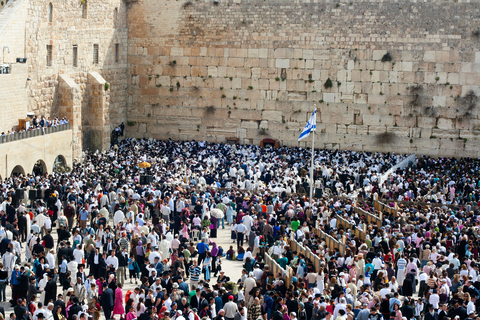
Jerusalem 1994: I left Israel after 5 years on kibbutz and returned 17 years later in the summer of 1994. I found that my biggest regret while I was away was not getting to know Jerusalem better when I lived in Israel. I hadn’t been religious then and I had no profound memory of contact with the Kotel (Western Wall). My only memory was of standing on the other side of the plaza and seeing it accross that distance.
 

In 1994 I was determined to make up for the past. My first day in Israel I made my way to the Wall, through the Old City's pushy merchants and sleazy would-be guides. My mind toyed with the fantasy: "I'll be here for 5 weeks "Maybe I'll go to the Kotel every day, why not?" That first day was very hot and I was physically uncomfortable wearing a tallit katan (undershirt with ritual fringes) under my clothes. I had purchased it expressly to use at the Kotel, since women are forbidden by Israeli law to wear regular tallitot (prayer shawls) at the Kotel.

I finally approached the smooth stones on the women's side after waiting for a space to open up. I stood there, wanting to pray and just couldn't: it was just too hot, too crowded, too hectic. The air was full of energy that just wasn't conducive to my prayer. It was supposed to be a big moment, but it wasn't.
 

My other experience of davenen (praying) at the Kotel was with the Women of the Wall: a group which started out a few years ago davenen with tallitot and reading from the Torah at the Kotel. Both chairs and obscenities were hurled at them then, and later the law was passed which forbids women from wearing tallitot, reading from the Torah and praying together as a group at the Kotel.

For Rosh Hodesh Elul (New moon gathering in the month prior to Rosh Hashana), the Women of the Wall group was large, some of the regulars said. When we gathered we were told that this would be an Orthodox service: nothing that required a minyan of 10 men would be included. We were also reminded to keep our voices down. Thus we davened, standing huddled together about 10 yards distance from the Kotel. I could hardly hear the voice of our Ba'alat Tefillah (Prayer Leader), but suddenly I could hear, quite loudly, a woman's voice in English scolding us "Don't you know the men can hear you? They aren't allowed to, you know very well..." and on and on.

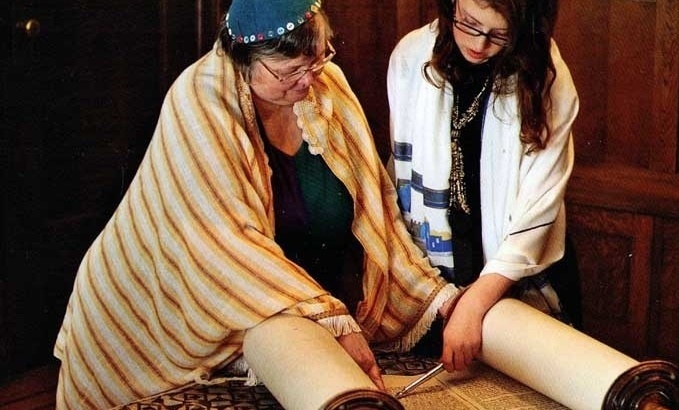
After the first part of the morning prayer service, we went as a group across the large plaza, up many stairs to a courtyard where we finished our service. We sang with full voices the Hallel (a special collection of psalms sung on holidays and at the new moon), read from the Torah, and finally blew the shofar (ram’s horn). After quietly whispering at the Kotel, the group had come alive: strong, intelligent women praying from their hearts and singing God's praises as if we were ‘free at last.’
 

I was invited by the group to officiate the Torah service, easily one of the biggest honors in my life. Quite likely this was as close as I would ever get to the Kotel with my tallit and tefillin (phylacteries usually worn by religious men) and by then I was willing to settle for the memory of that beautiful Hallel and Torah service.
 

Before Hallel, I noted a few black-hatted, black-clothed men watching us from an archway. I’d experience a man grabbing a scroll out of my hands before (in Canada), and I feared that our Torah might be forcibly taken from us. Someone said she thought they'd leave us alone. They did.
 

In the cartoon Peanuts, Lucy always entices Charlie Brown to kick the football while she steadies it for him. She always grabs it away at the last minute and laughs at poor, trusting Charlie Brown. I didn't go back to the Kotel. I was afraid to be disappointed. It was a painful realization that for me there were no spiritual highs to be had in the face of institutionalized disdain.
I never thought that I would thank God that I live in the Diaspora. Even though I cry every time I leave Israel, I seem to bloom much better planted here in Vancouver. My ‘lech l’cha’ (‘go out’ as God said to Abraham or more literally ‘go to yourself’) directs me to do my work here.

There is always an invisible thread that ties me to Israel and makes my breath catch hearing its name in a newscast. I now pray for the State of Israel with renewed kavana (intent): "May it be your will, Source of strength for all God-wrestlers, that balance be found in your holy places. May we all see past the false boundaries of gender and sect and learn to value and cherish one another. Lets all say: Amen."


Back to Top | Home

Contact Rabbi Mercy ~ Click to E-mail | 604.876.2770

© Rabbi Dina-Hasida Mercy ~ All rights reserved

Questions/Comments about this site? Contact the webmistress

Last updated: September 4, 2008